
Critique by Alexis Ingram
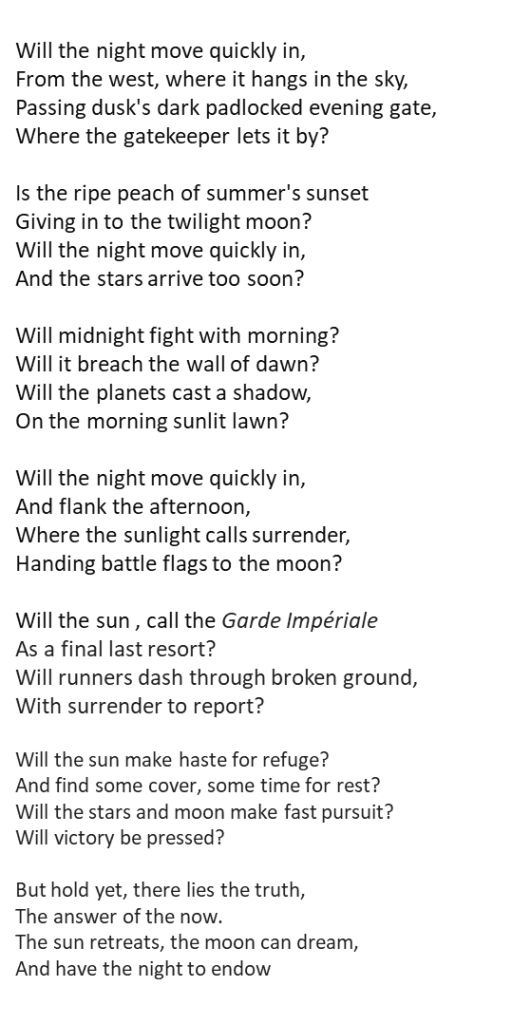
“Will The Night Move Quickly In?” by Francis Winifred presents a contemplation on the passage of time and the cyclical nature of day and night. The poem employs vivid imagery and a series of rhetorical questions to evoke a sense of movement and transition.
The opening stanza sets the scene with a picturesque description of the night’s arrival, utilizing phrases like “dark padlocked evening gate” to convey a sense of anticipation and mystery. However, some lines, such as “Where the gatekeeper lets it by?” could be refined to enhance clarity and flow.
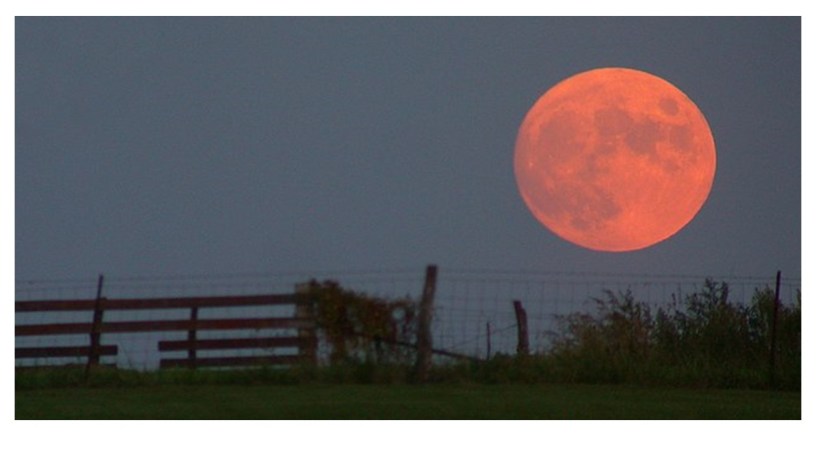
The poem skillfully explores the interplay between celestial bodies, such as the sunset yielding to the twilight moon and the transition from midnight to morning. The use of celestial imagery creates a sense of grandeur and cosmic scale, inviting readers to contemplate the vastness of the universe.
The poem also introduces elements of conflict and tension, as seen in the lines about midnight’s potential struggle against dawn and the imagery of battle flags being handed from sunlight to the moon. These lines add depth and intrigue to the poem, prompting reflection on larger themes of transition and change.
The concluding stanza offers a moment of reflection, suggesting that amidst the celestial dance of day and night, there lies a deeper truth to be discovered. The imagery of the sun retreating and the moon dreaming adds a sense of introspection and closure to the poem, tying together its themes of time, transition, and cosmic order.
Overall, “Will The Night Move Quickly In?” is a thought-provoking poem that skillfully combines vivid imagery, rhetorical questions, and thematic depth to explore the passage of time and the mysteries of the universe. With some refinement for clarity and cohesion, it has the potential to resonate deeply with readers.
School of Poetry
“Will The Night Move Quickly In?” by Francis Winifred aligns with several schools of poetry due to its thematic and stylistic elements. It exhibits characteristics of Romanticism, with its focus on nature, the sublime, and the exploration of the human experience within the context of the natural world. The poem’s vivid imagery and contemplation of celestial bodies evoke a sense of awe and wonder often associated with Romantic poetry.
Additionally, the poem displays elements of metaphysical poetry, characterized by its use of complex metaphors, exploration of philosophical themes, and blending of the mundane with the spiritual or cosmic. The questions posed throughout the poem about the passage of time, the relationship between celestial bodies, and the deeper truths underlying existence align with the intellectual and speculative nature of metaphysical poetry.
Furthermore, the poem’s use of rhetorical questions and introspective tone also reflects elements of lyric poetry, which often focuses on the expression of personal emotions, thoughts, and reflections. The poem invites readers to contemplate the mysteries of the universe and their own place within it, encouraging a subjective and emotional response.
Overall, “Will The Night Move Quickly In?” exhibits characteristics of Romanticism, metaphysical poetry, and lyric poetry, reflecting a rich tapestry of themes and influences that contribute to its depth and complexity.
 Inalienable Write