
Hear reading
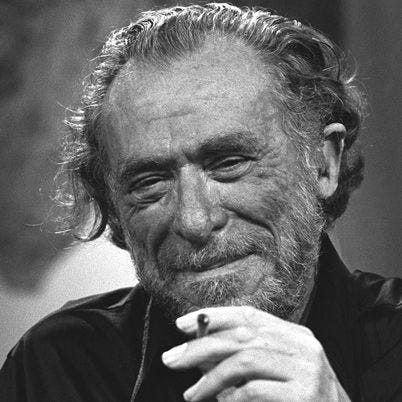
Charles Bukowski’s footprints
Are on the pavement to be found
And bottle caps
Are littered on the ground.
Each mark a spot,
Where he saw things,
That others could not,
Listening as the bluebird sings.
On these streets,
The hours of loneliness
Still make shadows.
The neon signs of Vegas
Are pouring hurt upon open cuts
Where the streets are filled with
Lunatics and nuts.
Where small victories are made
From bargains in a supermarket,
Where you sleep in your car,
Where ever you can park it.
Where you lay in the silence,
And listen to the
Whiskey flavoured bluebird.
11, 037 days under grass,
Where you lay in the silence,
Mutilated by love and no love,
In a world filled with violence.
Charles Bukowski’s footprints
Are on the pavement, against the odds,
You’ll find him still there,
Alone with the Gods.
Critique by Alexis Ingram
Francis Winifred’s poem “Bukowski” is a poignant homage to the legendary poet Charles Bukowski, capturing the essence of his life and work through vivid imagery and resonant themes. The poem’s structure is straightforward, employing quatrains and free verse to mirror Bukowski’s raw and unfiltered style. It effectively encapsulates Bukowski’s existential musings, his struggles with loneliness, and his indelible impact on the literary world.
The opening stanza sets the tone by situating Bukowski’s presence on the pavement, with “footprints” and “bottle caps” symbolizing his journey and the remnants of his turbulent lifestyle. These concrete images ground the poem in the gritty reality Bukowski often depicted, creating an immediate connection to his world.
“Each mark a spot, / Where he saw things, / That others could not,” evokes Bukowski’s unique perspective on life, his ability to find profound meaning in mundane or bleak circumstances. The mention of the “bluebird” is a direct nod to Bukowski’s own poem “Bluebird,” symbolizing the fragile, hidden parts of the self that endure despite life’s harshness. This reference enriches the poem, aligning Winifred’s homage with Bukowski’s own themes of vulnerability and resilience.
The subsequent stanzas delve deeper into the loneliness and desolation Bukowski frequently wrote about. The “hours of loneliness” casting “shadows” and the “neon signs of Vegas” that “pour hurt upon open cuts” encapsulate the pain and alienation felt by many of Bukowski’s characters. The imagery of “lunatics and nuts” populating these streets further emphasizes the marginalization and madness Bukowski observed in urban life.
Winifred captures the small, often overlooked victories that define survival in Bukowski’s universe. The stanza describing “bargains in a supermarket” and sleeping “in your car, / Where ever you can park it” highlights the everyday struggles and the fleeting triumphs of ordinary people. This portrayal resonates with Bukowski’s focus on the downtrodden and his celebration of their endurance.
The repetition of “where you lay in the silence” in the penultimate stanza underscores the pervasive solitude and contemplation that marked Bukowski’s existence. The phrase “whiskey flavoured bluebird” intertwines his affinity for alcohol with his inner turmoil, suggesting that even in his darkest moments, there was a glimmer of poetic beauty.
The final stanza, with its mention of “11,037 days under grass,” poignantly marks Bukowski’s death, encapsulating his life’s duration in a stark, numerical form. This leads to the reflective lines about being “mutilated by love and no love, / In a world filled with violence,” capturing the dichotomy of Bukowski’s experiences and the brutality of the world he inhabited.
The poem concludes with a powerful affirmation of Bukowski’s enduring presence: “You’ll find him still there, / Alone with the Gods.” This ending suggests that despite the chaos and hardship of his life, Bukowski’s legacy remains indomitable, his spirit continuing to influence and inspire.
In “Bukowski,” Francis Winifred masterfully captures the essence of Charles Bukowski’s life and work. Through evocative imagery and thematic resonance, the poem pays tribute to the poet’s unyielding exploration of human suffering, resilience, and the quest for meaning amidst life’s chaos.
School of Poetry
Francis Winifred’s poem “Bukowski” can be associated with the school of poetry known as Confessional Poetry, although it also carries significant influences from the Beat Generation. Here’s an analysis of why it fits into these categories:
Confessional Poetry:
Confessional Poetry emerged in the mid-20th century, characterized by its focus on the personal and the autobiographical, often dealing with themes of mental illness, sexuality, and personal trauma. This style of poetry is known for its raw honesty and directness.
- Personal and Autobiographical Elements: The poem reflects deeply personal themes such as loneliness, pain, and the struggle for survival, which are central to Confessional Poetry.
- Emotional Intensity: The emotional intensity of the poem, with its vivid imagery of hurt and small victories, aligns with the confessional style of revealing deep personal experiences and emotions.
Beat Generation:
The Beat Generation, a literary movement that emerged in the 1950s, is characterized by its rejection of standard narrative values, exploration of religion and spirituality, and open discussion of sexuality, drug use, and a general disdain for materialism and institutionalized structures.
- Influence of Charles Bukowski: Charles Bukowski himself is often associated with the Beat movement, even though he wasn’t a central figure within it. His raw, unfiltered style and focus on the lives of marginalized individuals were heavily influenced by the Beats.
- Street-level Realism and Grit: The poem’s references to the gritty realities of urban life, including images of bottle caps, neon signs, and sleeping in cars, reflect the Beat aesthetic of exploring the raw and unpolished aspects of life.
- Anti-establishment Sentiment: The themes of isolation, marginalization, and finding beauty in the mundane resonate with the Beat Generation’s ethos of questioning societal norms and valuing individual experience.
Conclusion:
Winifred’s “Bukowski” can be seen as a confluence of Confessional Poetry and the Beat Generation. It combines the personal, emotive depth characteristic of Confessional Poetry with the raw, observational, and often anti-establishment style of the Beat poets. The poem’s homage to Charles Bukowski, a figure who straddles both these literary traditions, further cements its place within these overlapping schools of poetry.
 Inalienable Write