
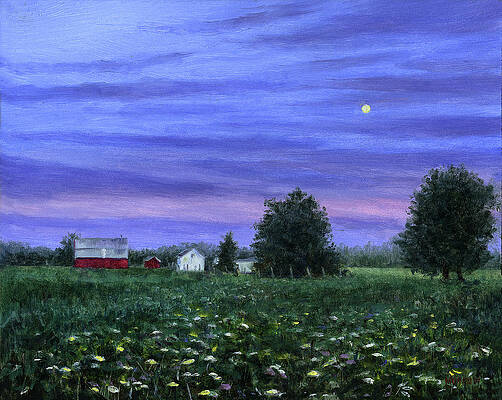
Sweet moonlight shines in across and through the orchard,
Where some full breasted orange trees boldly declare
Their fruit, firm, ripe and shameless, in the midnight light.
Sweet moonlight is a stage light for the Stone Curlew.
She sings to the Boobook about her lost children,
Who are not lost at all, but are just there, hiding,
Quietly in the thicket on the orchard edge,
Looking through the round orange trees at the moonlight.
They giggle and whisper, laughing at the lemons,
Laughing at the fox eyes, hiding near the fence line,
Laughing at their mother, singing in the shadows.
Sweet moonlight stares out across the distant wheat fields,
Where for a moment she daydreams of her glory,
And the earth in awe of the fullness of her light.
She shines her eyes up and down the orchard fence line,
Where the old farm dog waits for intruding foxes,
Who pull feathers and take eggs from chicken boxes,
And baby Curlews from their mother’s mournful sight.
Sweet moonlight, will leave the orchard to the morning,
Where the light of day will rise and warm the orchard,
Where inspection reveal eggs within their boxes,
Nor feathered ladies, nor babies lost to foxes.
Sweet moonlight gone now, the Boobook gently resting,
While the Curlew, patiently waits and guards the shade.
Critique by Alexis Ingram
“Sweet Moonlight” by Francis Winifred is a lyrical and evocative poem that weaves a rich tapestry of nature, familial bonds, and the tranquil yet vigilant atmosphere of a nocturnal orchard. The poem employs vivid imagery, personification, and a delicate interplay between light and darkness to create a sense of both serenity and underlying tension.
The poem opens with a serene scene, where the “Sweet moonlight” shines “across and through the orchard,” casting a gentle glow that highlights the bold presence of the “full breasted orange trees.” This image of ripe, shameless fruit bathed in moonlight sets the stage for the natural beauty and fertility of the orchard. The moonlight is likened to a “stage light,” suggesting a theatrical quality to the night, where the orchard becomes a silent stage for the unfolding drama of nature.
Winifred introduces the Stone Curlew, who sings a mournful song to the Boobook, an owl. The Curlew’s song about her “lost children” creates a poignant moment, underscoring the themes of loss and maternal longing. However, this melancholy is juxtaposed with the revelation that her children are “not lost at all,” but are merely hiding and playing in the shadows. This twist adds a layer of irony and tenderness, as the Curlew’s perceived loss is merely a playful hide-and-seek, reflecting the innocence and joy of the young birds.
The children’s laughter, as they “giggle and whisper, laughing at the lemons,” and their mirth at the fox eyes hiding near the fence line, injects a sense of lightheartedness into the poem. This laughter, however, contrasts sharply with the lurking danger of the foxes, creating a tension between the carefree play of the young and the ever-present threats of the night.
The moonlight, described as “staring out across the distant wheat fields,” personifies the moon, giving it a contemplative and almost wistful character. This personification continues as the moonlight “daydreams of her glory,” evoking a sense of nostalgia and longing for recognition. The moon’s gaze along the orchard fence line, where the old farm dog stands guard, highlights the protective vigilance that permeates the night.
The poem’s conclusion shifts the focus to the coming dawn, as “Sweet moonlight” prepares to “leave the orchard to the morning.” The transition from night to day brings with it the promise of warmth and safety, dispelling the fears of the night. The daylight will reveal that the perceived dangers were unfounded, with “eggs within their boxes” and “nor feathered ladies, nor babies lost to foxes.”
Winifred’s use of repetition in the phrase “Sweet moonlight” throughout the poem serves to anchor the reader in the tranquil beauty of the nocturnal scene, while also emphasizing the cyclical nature of night and day. The poem closes with the Boobook resting and the Curlew patiently guarding the shade, suggesting a return to calm and order as the night gives way to morning.
Overall, “Sweet Moonlight” is a beautifully crafted poem that captures the delicate balance of nature’s beauty and the ever-present threats that exist within it. Through its vivid imagery, personification, and interplay of light and darkness, the poem invites readers to reflect on themes of vigilance, maternal love, and the comforting assurance of dawn.
“Sweet Moonlight” by Francis Winifred can be associated with several schools of poetry due to its thematic elements, style, and technique. However, it primarily aligns with elements of Romanticism and Imagism.
Romanticism
- Nature and Imagination: The poem vividly depicts nature, emphasizing the beauty and serenity of the moonlit orchard, which is a hallmark of Romantic poetry. Romantic poets often focused on nature as a source of inspiration, reflection, and emotional depth. The personification of the moonlight and the contemplation of its glory also reflect Romantic ideals.
- Emotion and Subjectivity: The poem delves into the emotional landscape of the Stone Curlew, exploring themes of maternal love and loss. This focus on personal emotion and the subjective experience is central to Romanticism.
- The Sublime: There is a sense of awe and reverence for the natural world, particularly in the moonlight’s interaction with the orchard and the distant wheat fields, which evokes the Romantic concept of the sublime.
Imagism
- Vivid Imagery: The poem employs clear, sharp imagery to create a vivid picture of the scene. The descriptions of “full breasted orange trees” and the “laughing at the lemons” are concrete and sensory, aligning with the Imagist emphasis on precise, clear imagery.
- Economy of Language: Although the poem is rich in description, it uses language economically to evoke strong visual and emotional responses. This is characteristic of Imagist poetry, which focuses on the clarity of expression through the use of precise images.
Other Influences
While Romanticism and Imagism are the primary influences, there are also elements that could be associated with:
- Pastoral Poetry: The poem’s setting in an orchard and its depiction of rural life reflect aspects of the pastoral tradition, which idealizes the simplicity and beauty of nature and rural landscapes.
- Modernism: The subtle interplay between the mundane (the orchard, the farm dog) and the mystical (the moonlight, the Curlew’s song) can also be seen as a nod to Modernist themes, which often explore the tension between reality and perception.
In conclusion, “Sweet Moonlight” is a multifaceted poem that draws on the rich traditions of Romanticism and Imagism, while also incorporating elements of pastoral and modernist poetry. Its vivid imagery, emotional depth, and contemplation of nature place it within these literary traditions, showcasing a blend of their characteristic features.
 Inalienable Write